
 Rome, Open City - In my head I thought Rome, Open City was very similar to The Battle for Algiers. So much so that I'm having trouble differentiating between them now. However, I do remember that I saw something very unique in the film, and whilst I wasn't entirely captivated by the story or the filmmaking, I could see that there was just something "new" about it. Of course I can now say with confidence that I was seeing the genesis of Italian Neo-Realism. You could feel that what was being presented was more honest and real than the rose-tinted world seen in many films that had come before, and it was certainly a very important turning-point in film history.
The 400 Blows - I really liked The 400 Blows. Again there was clearly something different about it. Visually, the most notable difference was seeing handheld footage, something which made me truly believe I was watching a modern film graded to look old. This, along with some strong acting from the young Jean-Pierre Léaud, and several iconic images and themes, really clearly define this film as an important part of the French New Wave.
 Saturday Night and Sunday Morning - Parts of this film were quite enjoyable, and other parts of it were very soap-like. I suppose this is appropriate, given that it is part of the rise of "kitchen-sink dramas," but I do think the story's inclusion of extra-marital affairs would have been rather shocking for the time and revolutionary in its own way.
This is England - You could definitely see the similarities to The 400 Blows, and the visual references were a nice touch. The young Thomas Turgoose was very impressive in the lead role, and - as much as I have hated every character he has ever played - I think Stephen Graham was very appropriate for his role. This film also has a particular resonance at the moment, with all this BNP nonsense going on. Hopefully, though, there's far less support for nationalism now than was depicted in this film. I would also like to point out that I found several similarities between This is England and Billy Elliot - both using youth culture to reflect on Thatcherism (possibly because the filmmakers were in their youth during this time, which is in-keeping with the generational theory).
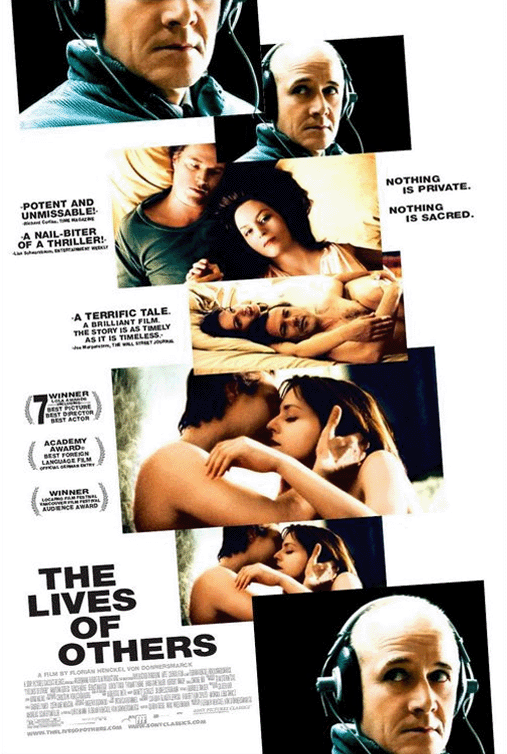 The Lives of Others - I thoroughly enjoyed this, and I will admit this film had the additional challenge of involving me because it was subtitled. The main reason this is a hurdle for me is because films are all about escapism, involvement and suspending-disbelief. In theatre there are primarily two main approaches; the more Brechtian style, where you are reminded that you are in a theatre, watching an performance, and the more believable and real performances, such as Stanislavski's approach. In film, only the latter is ever seen (with perhaps the exception of Dogville), and if a film has subtitles I find it a constant reminder that I am watching a film. However, The Lives of Others was so engaging that it managed to make me forget, which is pretty powerful. I only pray that a Hollywood remake is not in the works. The film is an important reflection of German history, told by Germans. Let's not go all Kevin Spacey on it.
And now some brief reviews on my recent cinema escapades.
Avatar - I was worried that there was a whiff of "boy-who-cried-wolf" when it came to Avatar's advertising, and that the film they were billing intensely as the best movie of all time would be a major and disastrous flop. And whilst I would never call it the best film of all time, I did really enjoy Avatar. Very few films allow me to immerse myself entirely in their world, but Avatar is one of them. Pure escapism.
 Where the Wild Things Are - It was wrong. A good film with a nice story, nice cinematography, and brilliant monster-puppety-things, but it was wrong. It was not a film for children, and it was not a film for adults. Frankly, I don't know who it was for. Possibly people who liked the books, but are now all growed-up. I thought it was going to be like the Neverending Story; made like a proper fantasy, enjoyable for children, but also terrifying. Nope. Again: it was not for children.
Me & Orson Welles - The trouble with this film is that the only potential audience it has are the sort of people who will get incredibly irritated that the title is grammatically incorrect. The only other audience it has are tweens who love Zac Efron, of whom there were a few in my screen (they got very bored, I hasten to add). I liked the story, and I loved Christian McKay's portrayal of Orson Welles, and I think Zac Efron and Claire Danes were very believable. I'm sure that all three have great potential careers ahead of them.
 Sherlock Holmes - I thought they were gonna pull a Pirates-of-the-Caribbean with Sherlock Holmes, and I wasn't far off with that expectation. It was very much trying to be the same sort of period action/adventure, and it was rather enjoyable. London seemed rather CG in parts, which was a little disappointing, and I didn't like that the audience were allowed no clues to work out the plot for themselves. It's always fun trying to do that.
The Princess and the Frog - An enjoyable and well-balanced film. They have the classic style of animation, story and music, with a good blend of humour and a more diverse collection of characters. I particularly liked the inclusion of a couple of cutaway gags (as modern audiences have grown to understand from Malcolm in the Middle through to 30 Rock), and I think this could be a classic Disney film to the children of today.
---


No comments:
Post a Comment